


It’s time to say it out loud: The old outbound lead generation playbook is dead. If your team is still firing off mass email sequences and hiding valuable content behind lead forms, you already know something is off. Response rates have cratered, and customer acquisition costs (CAC) keep climbing. And the much-touted “personalization” that was supposed to fix everything? That’s an AI;DR bust. Prospects can spot an LLM-generated icebreaker from the subject line alone, and they’re deleting it without a second thought.
The uncomfortable truth is that most outbound lead generation strategies being used today weren’t built for 2026. They were built for a world that no longer exists, a time before AI flooded every inbox with effortless, indistinguishable noise. Need proof? Only 18% of marketers in a recent survey said they believe outbound lead generation practices provide high-quality leads.
The good news is that outbound still works, but it requires a fundamentally different approach. When every competitor is racing to the bottom with generic automation, the companies that are winning pipeline are the ones willing to do things that automation simply can’t replicate.
For example, email outreach that uses advanced, signal-based personalization that demonstrates deep research into a prospect’s specific business challenges generates an 18% response rate, over 5x higher than the 2026 industry average of 3.43% for generic, automated outreach. In a market saturated with low-cost noise, this kind of Proof of Effort has become the ultimate differentiator.
Here are fourteen proven but surprising outbound lead generation strategies that are actually cutting through in 2026. Some will feel counterintuitive, and a few might feel like a step backward—but that’s exactly the point.
Why Outbound Lead Generation Needs New Strategies in 2026
The problem with the old playbook is that the tactics that worked three years ago have been fully commoditized.
The New Buyer Profile: AI-First and Millennial-Led
Consider that gated whitepapers are slowly going extinct as 95% of B2B buyers utilize AI and LLMs to support their decision and purchase process. 55% of these buyers are Millennials, and 65% of them will only accept outreach from a sales rep if it’s highly customized.
The “AI Penalty” and the Trust Gap
Mass-automated AI email sequences are not only underperforming, they’re actively damaging sender reputation and burning through the goodwill of prospects who are now conditioned to ignore them. Inboxes today are flooded with AI-generated personalization like job-title callouts and company mentions that sound human but feel hollow, because when AI optimizes based only on email data, it’s making decisions with approximately 5-10% of the customer picture.
A U.S. university study showed that the “AI penalty” of suspecting an email was generated by AI suggests to recipients that the sender is lazy, less friendly, less trustworthy, or less authentic. If that’s what the general population thinks, good luck trying those tactics on sophisticated buyers like the senior decision-makers you’re trying to reach.
The Rise of “Dark Social”
At the same time, the traditional inbound funnel is also quietly breaking down. Prospects have moved their real buying conversations off public social media platforms and into “Dark Social.”
This anti-social network consists of private Slack groups, Discord servers, invite-only communities, and niche forums that never show up in a Google search. 84% of all online content sharing occurs through “Dark Social” channels, private messages, emails, and closed communities that your standard analytics never see.
The Cost of the Old Funnel
Waiting for someone to fill out a form is increasingly a losing game. By the time a prospect raises their hand, they’ve already shortlisted vendors and mostly made up their mind. On top of all that, ad platforms are more crowded and expensive than ever, making broad awareness campaigns a poor use of budget for most startups. But all hope is not lost.

Leverage Relationships & Analog Luxury Signals
To have success in outbound lead generation today, you need to change your strategies from lead volume to relationship pipelines, and from name-gathering to genuine, well-timed human engagement. That’s why companies that excel at lead nurturing generate 50% more sales-ready leads, at a 33% lower cost, than those that don’t.
What works now is what can’t be easily automated: physical mail, researched voicemails, intent-based timing, and B2B marketing content that proves a real human spent real time on a specific prospect.
These are the Analog Luxury signals: the physical and human touchpoints that, precisely because they’re rare, communicate high-status intent and trustworthiness in a way that no automated sequence ever can. In other words, it’s time for a new outbound lead generation playbook that freshens up a few proven tricks with surprising twists.
14 Proven but Surprising Outbound Lead Gen Strategies
These fourteen strategies, grouped in four categories, leverage Analog Luxury signaling to drive outbound lead generation in a buyer environment that’s starved for Proof of Effort:
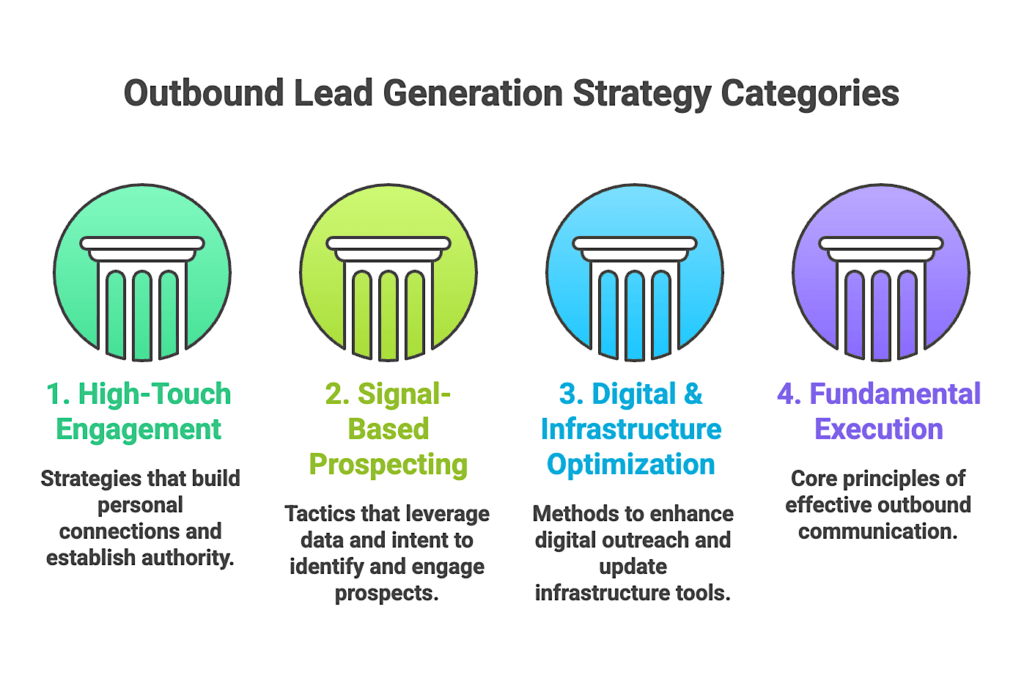
High-Touch Engagement & Authority Plays
1. The Physical-to-Digital Bridge (Lumpy Mail 2.0)
Send a high-value physical mailer, such as a relevant business book or a personalized package, containing a unique QR code. The code directs the prospect to a dynamically personalized landing page designed for conversion optimization that features a bespoke video pitch made specifically for them.
Recent studies show that physical mail in the tech industry has a 51.06% open rate and a 4.3% response rate, while 74% of marketers report getting the best ROI through direct mail marketing compared to other promotional channels. The combination of a pattern-interrupting physical touchpoint with a perfectly timed digital follow-up creates a “Moment of Relevance” that no automated email sequence can replicate.
The Playbook:
- Select a high-value physical item relevant to the prospect’s specific role or industry: a book, a curated toolkit, or a branded package with a clear hook.
- Include a unique QR code tied to a dynamically personalized landing page built specifically for that account.
- Set up a real-time alert to notify sales the moment the QR code is scanned. Perform follow-up sales outreach by phone while the brand is still in the prospect’s hands.
- Track scan rates and landing page engagement to identify your warmest accounts for immediate prioritization.
2. The “Ghostwriting” Trojan Horse
Reach out to high-level leads requesting a brief expert quote for an upcoming industry whitepaper or original research report. It’s a zero-pressure, high-status ask that bypasses gatekeepers and naturally leads to a clarification call to discuss their specific expertise, at which point the discovery conversation you actually wanted is already underway.
Research is a high-status activity; selling is low-status. Positioning the prospect as an authority allows their defensive barriers to drop, and you gain authentic insight into their strategic priorities before ever making a pitch.
The Playbook:
- Commission or produce a genuine industry report or whitepaper. The asset must be credible and worth being quoted in.
- Identify 10–15 Tier-1 prospects whose job title and expertise make them a natural authority on the report’s topic.
- Send a concise, flattering outreach email requesting a single expert quote. Keep the ask small and the pressure nonexistent.
- Follow up with a brief clarification call to discuss their perspective in more depth, using that session as your discovery conversation.
3. Bespoke Manual Personalization
This one might be controversial, but consider replacing automation entirely for Tier-1 accounts. Instead, build 100% handcrafted outreach based on deep-dive research across earnings filings, recent press, podcast appearances, product launches, hiring patterns, and whatever news tells you something real about where this person’s head is. Then, deliver it via the prospect’s most active channel.
In an era of AI-generated personalization, true manual labor stands out as an unmistakable signal of high intent and respect for the prospect’s time. Sophisticated executives with heightened “spot a bot” abilities will notice the difference, and that notice translates directly into response rates.
The Playbook:
- Define a shortlist of genuine Tier-1 accounts. This approach only scales to 10–20 targets at a time.
- Research each prospect across multiple sources: 10-K filings, LinkedIn activity, podcast appearances, press releases, and recent company news.
- Write every message from scratch with a specific, demonstrably researched reference that could not have been automated.
- Identify the prospect’s most active channel (LinkedIn, email, X/Twitter) and lead with outreach there.
4. The 1:1 Podcast Invite
Invite a Tier-1 prospect to be a featured guest on a niche industry podcast or executive video series. The recording session secures a 45-minute calendar block that functions as an undercover, high-fidelity discovery conversation. It’s the kind of undivided C-suite attention that would be impossible to buy through traditional outreach.
The power dynamic shifts from “Vendor/Buyer” to “Producer/Expert,” which puts the conversation on entirely different terms. By the time the real conversation happens, there’s already a foundation of mutual respect and genuine interest.
The Playbook:
- Launch or maintain a niche podcast or executive interview series with a credible audience, even if modest in size.
- Identify Tier-1 prospects whose expertise genuinely aligns with the show’s theme. The invite must feel earned, not manufactured.
- Frame the outreach around their specific expertise and what their perspective would contribute to your audience.
- Treat the recording session as a structured discovery call. Prepare questions that surface strategic priorities and budget context organically.
Signal-Based & Intent Prospecting
5. The “Recruiter” Proxy Angle
Monitor job boards for specific leadership roles within your target account list. When you spot a role like “Director of Demand Gen,” reach out to the hiring executive offering a bridge solution to plug that functional gap while they navigate the months-long hiring cycle.
A legitimate job posting is a public confession of pain. It proves budget exists and that there is an immediate operational deficit. Framing your service as a plug-and-play fix for a high-priority KPI problem is a far more compelling pitch than a cold product demo.
The Playbook:
- Set up automated job board alerts (LinkedIn Jobs, Indeed, Greenhouse, etc.) filtered by role type and target account list.
- Identify the hiring executive, typically the direct manager of the open role, as your outreach target.
- Lead with the gap, not your product: acknowledge the hiring challenge and position your offering as an immediate bridge solution.
- Time outreach within the first two weeks of the job posting appearing, when the pain is freshest.
6. “Dark Social” & Private Community Listening
Identify and monitor gated B2B communities such as Slack groups, Discord servers, and niche forums, looking for keywords related to pain points or competitors. When a relevant thread surfaces, engage via a peer-level DM with a high-value, non-sales resource that addresses the exact issue they just raised.
Buyers have migrated to these “Dark Social” private spaces for honest, unfiltered peer discussions. Showing up as a genuine contributor rather than a vendor in these Blue Ocean channels provides an advantage that the public LinkedIn feed simply cannot offer.
The Playbook:
- Map the communities where your ICP has honest conversations: industry Slack groups, Discords, subreddits, and niche forums.
- Join as a legitimate member and contribute value before monitoring for commercial signals.
- Set keyword alerts for competitor names, pain-point language, and product category terms.
- Respond to relevant threads via DM with a specific, helpful resource with no sales pitch attached: a Loom walkthrough, a relevant article, or a tool recommendation that genuinely addresses their problem.
7. Real-Time Event-Driven Outreach (The Newsjack)
Launch a targeted outbound lead generation push immediately following a macro industry event, regulatory shift, or macroeconomic occurrence. Lead with content-based outreach that explains how your solution mitigates the specific risks or capitalizes on the opportunities that just emerged.
When an industry-wide event happens, the cost of inaction becomes a board-level topic almost overnight. It transforms a generic pitch into a timely strategic intervention, making the case for urgency without ever having to manufacture it.
The Playbook:
- Monitor industry news, regulatory feeds, and macroeconomic developments relevant to your ICP’s world.
- When a significant event breaks, move within 24–48 hours. Speed is your competitive advantage here.
- Lead outreach with a content asset (a quick analysis, a one-pager, a short video) that frames the event and positions your solution as the response.
- Keep the message event-specific: reference the exact development and explain the direct connection to your value proposition.
8. Intent-Based Trigger Campaigns
A trigger-specific sequence is a short series of touchpoints, typically two to four outreach attempts across email, phone, and LinkedIn, with each written specifically around the trigger event, with messaging that connects your offering directly to the organizational change the prospect is navigating.
Automate trigger campaign outreach based on organizational inflection points such as funding rounds, M&A activity, or leadership changes, with a strict 48-hour response window from the moment the data trigger hits your CRM.
New CMOs tend to audit vendors and reset agency relationships early in their tenure, making the window of first contact unusually high-value. For example, a company that just closed a Series B is immediately in build mode. Timing outreach to a vulnerability window like this ensures you are present during a period of mandated organizational change, when the appetite for new partnerships is at its highest.
The Playbook:
- Use intent data tools (such as Bombora, 6sense, or LinkedIn Sales Navigator alerts) to monitor your target account list for trigger events.
- Build pre-written, trigger-specific sequences in your CRM for each trigger type: funding rounds, leadership changes, M&A activity, etc. Keep response time under 48 hours.
- Tailor the value proposition in each sequence to the specific context of the trigger event, and don’t use your standard pitch.

9. The “Inbound-Led Outbound” Flywheel
Use de-anonymization tools to identify companies visiting high-intent pages like pricing and case studies that have not yet converted via a form. Route this data to sales to initiate outbound sequences to the specific personas within those identified accounts while interest is still high.
Research indicates that 94% of buyers have already ranked their vendor shortlist in order of preference before they engage with sellers, meaning by the time a prospect raises their hand, the decision is largely made. This approach lets you intervene during the active consideration stage rather than waiting for a form fill that may never come.
The Playbook:
- Implement a de-anonymization tool (e.g., Clearbit, RB2B, or Leadfeeder) on high-intent pages like pricing, case studies, and demo request pages.
- Define the threshold for sales routing: e.g., any account visiting the pricing page more than twice in seven days.
- Map the visiting company to specific buyer personas within that account and initiate a targeted outbound sequence immediately.
- Personalize outreach to reflect that they are already in a research phase. Do not treat them like a cold prospect.
Digital & Infrastructure Optimization
10. Programmatic Account-Based Advertising (ABA)
Run targeted display or social ads exclusively to the specific individuals currently being worked by the sales team, using programmatic tools to surround those prospects with brand impressions across their preferred web and social channels.
By the time a prospect receives an email or call, they feel they’ve seen your brand everywhere, which decreases friction and increases perceived credibility without spending a dollar on broad awareness. This tactic lets you leverage the mere-exposure effect to build unearned brand authority at a fraction of the cost of traditional advertising.
The Playbook:
- Sync your active sales sequences with a programmatic ABM platform (e.g., Demandbase, Terminus, or LinkedIn Campaign Manager).
- Upload contact lists of prospects currently in active sequences and serve targeted ads across LinkedIn, display networks, and relevant content sites.
- Keep ad creative tightly aligned to the messaging in the outbound sequence. Consistency across touchpoints is what creates the “everywhere” effect.
- Run campaigns for the duration of the sales sequence, and not indefinitely. This campaign model is all about precision ad spend.
11. High-Context Video Prospecting
Send short (60–90 second), deliberately unpolished screen-share videos that use the prospect’s own website or LinkedIn profile as the visual hook: a walkthrough of a specific observation, technical gap, or opportunity found during research, delivered as a thumbnail in an email.
Visuals are processed significantly faster than text, and a video thumbnail of someone’s own homepage triggers an immediate curiosity gap. More importantly, it proves the outreach is not a mass-automated blast, and that proof alone sets it apart from the vast majority of what lands in any executive’s inbox.
The Playbook:
- Use a screen-recording tool (like Loom or Vidyard) to record a 60–90 second walkthrough. Keep it unscripted and conversational.
- Open the video with the prospect’s own website or LinkedIn profile visible onscreen to trigger immediate recognition.
- Focus the video on one specific, researched observation: a gap, an opportunity, or a relevant insight. Do not make it a product demo.
- Embed a video thumbnail (not a link) directly in the email body to maximize click-through rate.
12. Social Selling (Blue Ocean Channels)
LinkedIn is fully over-fished in 2026. It’s time to reel in your lines and move your outreach into platforms with lower B2B marketer density, such as X (Twitter) or niche digital forums. High-frequency engagement through sharp takes on industry trends and real-time audio spaces builds credibility in a less crowded environment, especially one that’s not filled with AI impersonators or generic slop.
This channel shift is pure attention arbitrage: lower noise means more informal, direct-to-executive access without the corporate filters and connection request friction of traditional platforms.
The Playbook:
- Identify where your specific ICP actually spends time outside of LinkedIn: X/Twitter, niche Substacks, industry Discord servers, or vertical-specific forums.
- Build a consistent presence by contributing original perspectives, and not just commenting on others’ posts.
- Engage directly with target executives on their public content before initiating any direct outreach.
- Use platform-native features (X Spaces, forum AMAs) to build visibility and credibility at scale with minimal cost.
13. Deliverability Engineering
This one’s a bit technical, but it will help get your email campaigns moving again. Harden your outbound infrastructure using secondary “lookalike” domains and automated inbox warming. Ensure your SPF, DKIM, and DMARC records are properly configured, and that volume is scaled gradually to maintain a high sender reputation.
From a CMO perspective, the primary business domain is a high-value asset. This infrastructure approach ensures that aggressive outbound experimentation doesn’t compromise the deliverability of vital transactional or marketing emails from the core domain, a risk that is easy to underestimate and expensive to fix after the fact.
The Playbook:
- Register secondary “lookalike” domains (e.g., getcompanyname.com or trycompanyname.com) for all outbound prospecting activity.
- Configure SPF, DKIM, and DMARC records on all sending domains before any outreach begins.
- Run a structured inbox warming sequence (using tools like Instantly or Lemwarm) for a minimum of 3–4 weeks before scaling volume.
- Keep your primary corporate domain sending strictly reserved for transactional emails, marketing campaigns, and executive communications.
Fundamental Execution
14. Strategic Voice Outreach (aka The Phone Call)
Yes, the phone call. A dedicated layer of direct-dial phone outreach, even in highly technical or “digital-native” industries, remains one of the highest-ROI plays available. Human-to-human interaction functions as a deliberate pattern interrupt for prospects who live in their inboxes and have learned to process and delete written outreach on autopilot.
In an era of asynchronous digital noise, the phone is the only channel that forces immediate engagement. For the right prospect at the right time, a well-researched, human call has become a rare differentiator simply because nobody is doing it anymore.
The Playbook:
- Reserve phone outreach for Tier-1 accounts and warm prospects. Do not use it as a cold blast tactic.
- Research each prospect before calling: reference a specific trigger event, piece of content, or company development in the opening line.
- Keep the call short and focused on one question or one value proposition. Earn the next conversation, and don’t try to close on the first call.
- Follow up every call with a brief, relevant email within the hour to reinforce the touchpoint and provide a next step.
Stop Running the Same Plays Everyone Else Is Running
The thread connecting all fourteen of these outbound lead generation strategies is the same: they work because they’re hard to fake. Physical mailers, manual personalization, intent-based timing, and real human voices are not scalable in the way that mass email sequences are, and that’s exactly what makes them effective. In a market where every competitor has access to the same AI tools and the same automation platforms, the willingness to do the difficult thing is the only durable competitive advantage left in outbound.
None of this means abandoning a complementary data-driven approach. The best outbound lead gen programs in 2026 are pairing intent data and signal monitoring with high-touch execution. Use technology to identify the right moment, then deploy human effort to make the most of it. Of course, building and running campaigns across all four of these categories, while also managing product, sales, and everything else a startup demands, is a tall order.
That’s where mvpGrow comes in. As a full-service, on-demand marketing agency built for fast-moving B2B SaaS and tech companies, mvpGrow handles outbound and inbound lead generation campaign management, so founders and CMOs can stay focused on growth. You get a bespoke, data-driven strategy focused on your ICP, GTM engineering to connect your stack and drive pipeline, and human-driven content that converts—all delivered by an experienced global team of experts that know how to run unconventional outbound programs that actually get results.
Book a free meeting with mvpGrow and find out which of these proven but surprising outbound lead generation strategies makes sense for your pipeline right now.

The Founder & Chief Getting Sh%T Done Officer of mvpGrow. After about 8 years as a hired hand some of the largest (and smallest) B2B SaaS companies worldwide I decided to hang up my employee slippers and lace up my growth agency cleats. But just because I’m an agency doesn’t mean we can’t chat (no charge). Please email me on any topic and I will gladly reply: eyal@mvpgrow.com