

The way buyers search is changing. If you’re still prioritizing keywords based on volume alone, you’re optimizing for visibility, not revenue. B2B buyers move between Google, AI tools, peer reviews, and comparison content before they ever take the leap to talk to your sales team.
With this shift, buyer intent keywords are becoming more valuable and, simultaneously, more misunderstood. If you are seeing healthy traffic that doesn’t convert, you might be facing intent misalignment.
As such, SEO is no longer just about ranking pages. 89% of B2B buyers now use generative AI as part of their buying process, adding a new research layer that traditional SEO alone can’t cover. Buyer intent keywords connect SEO as you know it with new, up-and-coming GEO best practices.
SEO vs GEO: Definition and Key Differences
SEO (Search Engine Optimization) focuses on helping your content rank in traditional search engines like Google. GEO (Generative Engine Optimization) is about making that same content easy for AI tools and generative search engines to summarize and recommend.
| Factor | SEO (Search Engine Optimization) | GEO (Generative Engine Optimization) |
| Definition | Optimizing content and technical signals to rank in traditional search engines and earn clicks. | Optimizing content so AI assistants and generative search tools can cite or recommend it in answers. |
| Primary goal | Rank and drive qualified organic traffic to your site. | Be cited or recommended in AI-generated responses, often before a click happens. |
| Main success metric | Rankings, organic sessions, CTR, and conversions from organic traffic. | Mentions or citations in AI answers, referral traffic from AI tools, assisted conversions, and shortlist inclusion. |
| How intent shows up | Queries with clear commercial signals (e.g., “best,” “pricing,” “alternatives”) map to landing pages designed to convert. | Prompts like “Which tool is best for…?” or “Compare X vs Y” pull from structured, decision-oriented content. |
| What content performs best | Comparison pages, alternatives hubs, pricing pages, solution pages, and intent-mapped case studies. | Decision-support content: structured comparisons, pros/cons, “best for” blocks, concise definitions, and evidence-backed lists. |
| What algorithms reward | Relevance, authority, technical health, internal linking, topical depth, and strong UX signals. | Clear structure, extractable answers, specificity, consistency, proof, buyer language, and easy-to-summarize formatting. |
| Ideal page structure | Optimized titles and metadata, clean H1–H3 hierarchy, internal links, schema, and fast load times. | Explicit headings, tight sections, bullets and tables, “who it’s for” blocks, FAQs, and proof embedded near claims. |
What are buyer intent keywords?
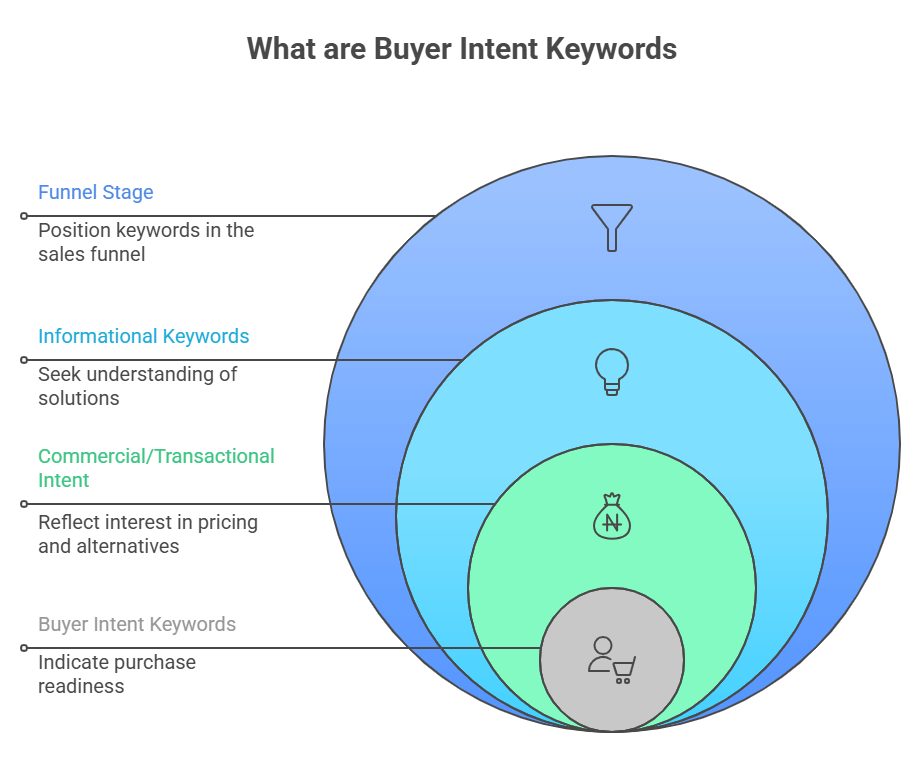
Buyer intent keywords are search queries that indicate your buyers’ intentions and readiness to purchase. They are highly valuable for B2B SaaS companies looking to understand whether prospects are actively considering solutions or vendors.
Informational keywords include things like ‘what are vCISO solutions,’ whereas buyer intent keywords reflect commercial or transactional intent. For example, they usually include words and phrases like best, pricing, alternatives, use cases, and more. These searches typically sit in the middle to the bottom of the funnel.
The importance of buyer intent keywords is that they drive qualified demand for B2B teams, which is where SEO and GEO become real revenue generators.
Types of Buyer Intent Keywords (With Examples)
- Best/top/leading signals active vendor research. Example: ‘Best cloud PAM solutions.’
- Alternative/competitor/vs indicates comparison between solutions they know about. Example: ‘Salesforce alternatives for SaaS startups.’
- Pricing/cost/ROI shows their readiness for budget consideration. Example: ‘Kubernetes cost calculator.’
- Use case plus scenario means buyers are connecting a specific problem to a category of solutions. Example article: ‘Company X Weaponizes Stolen Credentials to Deploy Ransomware.’
- Agency/service/software searches are a strong signal that the buyer wants help immediately. Example: ‘Technical SEO consultant for SaaS.’
Why Buyer Intent Keywords Matter in the Age of AI
Search volume was once one of the most important metrics in SEO. While it still holds value, conversion probability is the data to watch. In B2B, deal sizes can be large, and buying cycles are complex, meaning the keywords that matter the most are those that contribute to the pipeline.
Your content now needs to perform in two environments: traditional SERPs (Search Engine Results Page) and generative AI results. Buyer intent keywords help you write content that hits briefs for both categories. AI language models pull from proof-rich and decision-oriented content, which is exactly the type that buyer intent keywords are built around. At the same time, your content needs to clearly answer buyer questions and provide decision-making support so it ranks and gets cited by AI tools.
Step-by-Step: How to Find Buyer Intent Keywords for SEO and GEO
Step 1: Start with ICP Pain + Buying Language
Let’s start with your ideal customer persona’s (ICP) core problems. At this stage, you actually don’t need to think about keywords. Rather, you can investigate how buyers describe their situation when they’re ready to act.
Step 2: Build Competitor and Category Keyword Stacks
Now, you move on to the field research. Analyze competitors and similar tools in your industry or space. You’ll likely find recurring patterns in comparison pages and can form the foundation of your keyword research.
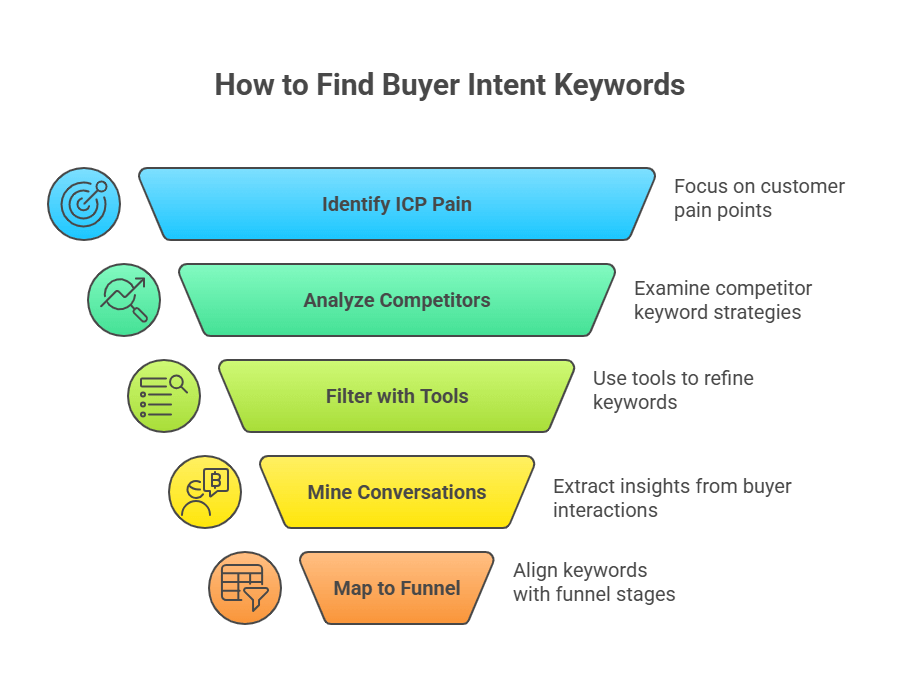
Step 3: Use Tools to Filter for Commercial Intent
SEO tools like Ahrefs and Semrush allow you to filter by intent or keyword modifiers. At this point, you’ll need to prioritize commercial and transactional queries over pure informational ones.
Step 4: Mine Real Buyer Conversations
Your existing customers are actually a goldmine of data. By reviewing touchpoints like sales calls, demo questions, customer service communications, and email threads, you’ll reveal high-intent keywords that you’ve missed.
Step 5: Map Keywords to Funnel Stages
Not all buyer intent keywords reflect the same intent. Some support early-stage evaluation, and others signal that they’re ready to buy. This is a good opportunity to map keywords to funnel stages, which helps you build content that moves buyers forward.
How to Use Buyer Intent Keywords Across SEO and GEO
Treating SEO as a Google-only play is a common mistake. Winners in today’s volatile buying markets need to deploy buyer intent keyword strategies across classic SEO and GEO. Let’s find out how these two work together in practice.
SEO: Capturing Classic Search Demand
In traditional SEO, buyer intent keywords perform best when they map directly to evaluation-stage assets. These pages are designed to help buyers make decisions, including:
- Comparison pages that align with mid-to-bottom funnel searches and consistently convert when done well.
- Alternatives hubs are pages that speak to buyers when they’re in a moment of re-evaluation. These are effective for backlinks and repeat visits.
- Industry plus solution landing pages combine context with a relevant solution that matches the conversion intent.
- Pricing and cost explainers that build trust through transparency and qualify leads if you’re in their budget.
- Case studies tied to intent keywords act as proof throughout the buyer’s evaluation.
The key to well-performing SEO is intent alignment. Each page should answer a core buyer question and offer a clear next step, whether that’s booking a call or exploring a related comparison.

GEO: Capturing AI Search and Recommendation Demand
As we discussed earlier in the article, LLMs power everything from chatbots to industry-specific generative AI tools, and follow recognizable patterns. Therefore, AI tools prioritize content that helps them summarize, compare, and recommend options clearly.
You can focus on creating content that’s easy for AI to extract and cite. AI tools tend to reward content that’s deeply specific to a buyer’s use case and rich with evidence and proof. As for the copy, easy-to-condense text written in real buyer language, under well-structured subheadings, is a must. Buyer intent keywords naturally push content in this direction.
To increase the likelihood your content shows up in AI-generated answers, you can:
- Put buyer intent keywords in H2s and H3s, as AI tools rely on structural clues.
- Use comparison tables to break down options, features, trade-offs, and use cases.
- Add decision-support info, such as who the tool is for and when to choose it.
- Embed proof directly into the content with stats and real outcomes rather than generic claims.
- Answer the exact question a buyer would ask an LLM, not just what you think they should know.
One of the best-performing content formats for GEO is the listicle, which is built around high-buyer intent keywords like ‘best X,’ ‘top Y,’ ‘tools for Z,’ and similar. Aligning the listicle with these keywords increases relevance and conversion potential from an SEO standpoint. It’s also beneficial from a GEO perspective, as you create content that directly answers the kinds of questions buyers ask AI tools when building shortlists.
The clear structure of listicles makes them viable for AI tools to search, as this type of content often uses numbered sections, bullet points, and comparison tables. Covering a topic comprehensively helps listicles rank clusters of related buyer intent queries, not just a single keyword. It’s about compiling all the key information in one place, helping buyers compare options quickly and even share a single link internally with buying committees.
With these distribution advantages and the wealth of proof you can pack into a listicle, this content format is reliable and highly valuable.
Making SEO and GEO Work Together For Real Results
Buyer intent keywords don’t drive pipeline as one-off blog posts. You can only unlock their full value when SEO and GEO are treated as a single growth system, full of proof-led content that influences the buyer’s decisions across channels.
Therefore, high-intent content should never be created in isolation. Every page should support a funnel stage and create momentum toward a decision, which is difficult to do as you scale.
As an on-demand B2B growth team, mvpGrow builds and operates SEO and content systems designed to capture high-intent demand and turn it into revenue. From buyer-intent keyword strategy to GEO-first content and GTM engineering, the focus stays where it belongs: on revenue impact.
Deal-influencing content that ranks in SERPs and gets cited in AI results starts with buyer intent keywords. But it scales with the right execution system behind it. Book a free growth consultation with mvpGrow and see how buyer intent keywords can become a repeatable growth engine for your business.

The Founder & Chief Getting Sh%T Done Officer of mvpGrow. After about 8 years as a hired hand some of the largest (and smallest) B2B SaaS companies worldwide I decided to hang up my employee slippers and lace up my growth agency cleats. But just because I’m an agency doesn’t mean we can’t chat (no charge). Please email me on any topic and I will gladly reply: eyal@mvpgrow.com