
What Does Zero-Click Search Mean for SEO?
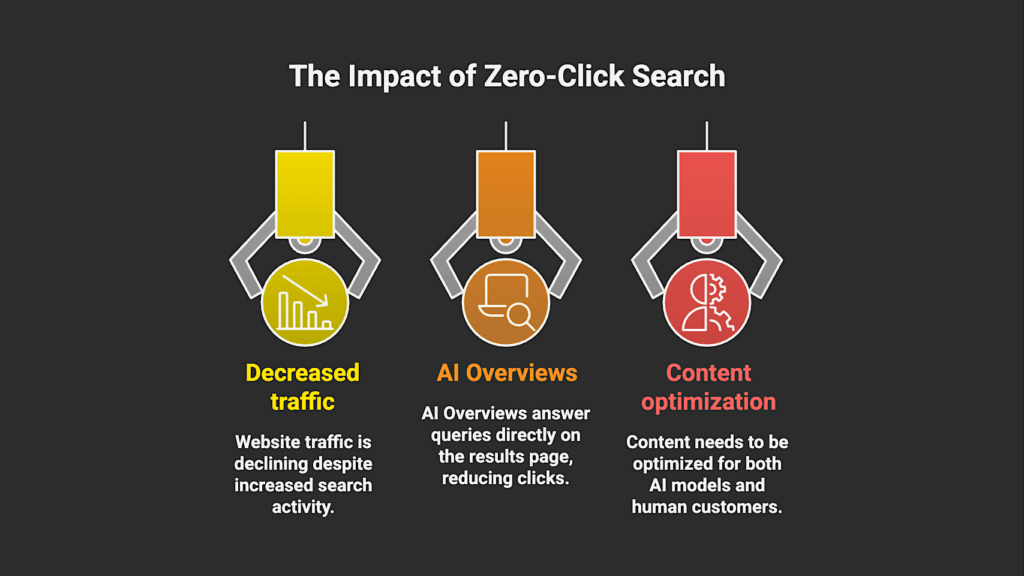
We are now living in a zero-click search world where AI Overviews and LLM-native search answer queries directly on the results page. They often satisfy user intent without a resulting click through to a website. Approximately 58.5% of U.S. Google searches end without a site visit, and AI overviews appear in roughly 50% of all searches, which means a significant share of your audience is forming opinions about your brand without ever landing on your domain.
For SEO, ranking on the SERPs is no longer enough. Your content also needs to be cited by the AI models answering the questions of potential customers. It needs to be optimized for two different audiences: the AI tools that decide whether to reference your brand, and the human consumer who ultimately makes a purchase. Let’s take a closer look at what zero-click search means for SEO, and the three-phase roadmap that will help you reach both audiences.
The Universal Zero-Click Search Challenge
First, let’s get clear on exactly what we mean by the zero-click challenge.
- A zero-click search is a query that ends on the results page or within the search tool itself, whether that’s a Google AI Overview or an LLM like Perplexity, without the user clicking through to an external website. The user’s intent is fully satisfied by the platform’s immediate response.
- Zero-click traffic is the brand exposure and authority a company gains when its information is displayed as the primary answer, despite no website visit occurring. It represents invisible reach where the value is measured in brand recognition and trust rather than clicks.
The challenge for brands is earning that invisible reach through AI citations during the discovery phase, while still giving potential customers a compelling reason to visit their site when it counts.
The Great Decoupling
The zero-click era has created a structural gap between brand visibility and website traffic, a phenomenon analysts call the Great Decoupling. As AI Overviews and LLM-native search satisfy more queries directly on the results page, organic referral traffic declines even as overall search activity grows. Recent industry studies show that organic click-through rates for queries featuring AI Overviews have fallen 61%, dropping from 1.76% to 0.61%.
How Pre-Purchase Research Has Changed
Pre-purchase research behavior has also shifted significantly. Recent data indicates that a majority of consumers across sectors engage in AI-assisted “pre-discovery” that shapes their initial consideration set before they ever visit a website or contact a provider. In B2B, 92% of buyers start with at least one vendor in mind, and 71% of software buyers rely on AI chatbots for research. In B2C, 55% of shoppers say they use AI to learn more about a product or category, such as what features to look for.
Becoming a Cited Source Is Critical
Since AI summaries are satisfying a substantial percentage of the discovery phase, becoming a cited source now acts as a critical method to influence initial consideration. If the AI fails to mention a brand during research, that company remains omitted from the purchase consideration set, and the opportunity to compete for business vanishes before a formal evaluation begins.
While this reality might feel like a signal to abandon traditional SEO, it’s not, because SEO is still effective and has real value. The solution is to evolve how we approach it.
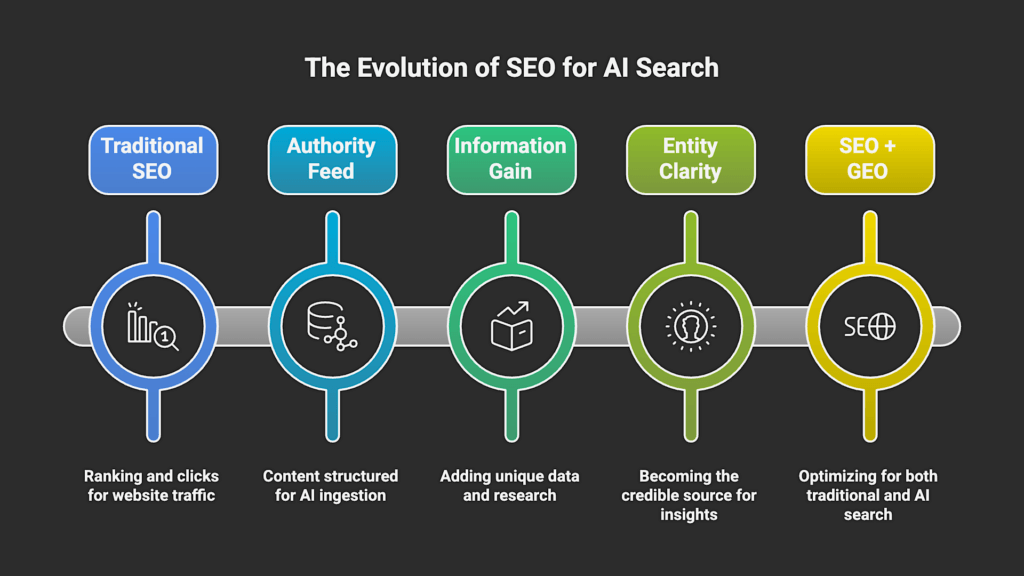
SEO Is Not Dead, It’s Different
From Gateway to Authority Feed
Search engines used to send people to websites. Your job was to get ranked, get clicked, and take it from there. While that is still true, today your marketing content also needs to function as an Authority Feed, a structured and reliable source of truth that generative engines pull from to build their summaries and overviews. If your content isn’t structured for ingestion by AI platforms, they will skip it and cite a competitor whose content is easier to parse and extract.
Information Gain
AI training data contains enormous volumes of published content, which means generative models are very good at recognizing recycled ideas. If your article covers the same ground as a hundred others, the AI has no reason to cite you specifically. What earns a citation is Information Gain, which is the degree to which your content adds something the AI cannot already synthesize from what it knows. Your content needs to contain something the AI cannot already synthesize on its own, such as proprietary data or original research your team has produced.
Entity Clarity
For years, SEO meant answering the questions your audience was searching for. That still matters, but it is no longer sufficient on its own. Generative engines do not just look for answers; they look for the most credible source of a specific answer. Entity Clarity is about becoming that source. When your brand consistently owns a specific data point or insight in your category, AI models begin to associate your name with that topic, and citation follows authority.
SEO + GEO = Visibility
Adapting to zero-click search successfully means optimizing for both traditional SEO and Generative Engine Optimization (GEO). The first keeps you visible in conventional search results, and the second builds the cited authority that earns your brand a place in AI-generated answers. Together, they create a compounding effect on brand visibility and click-through rates across every channel where your audience is searching.
3 Phases of an Optimized GEO/SEO Strategy
An optimized strategy needs to work on multiple fronts simultaneously: satisfying the machines that surface your brand in AI summaries, serving the humans who ultimately make the purchase decision, and measuring the marketing success of your GEO/SEO efforts. The following three-phase roadmap gives you a clear path to do all three:
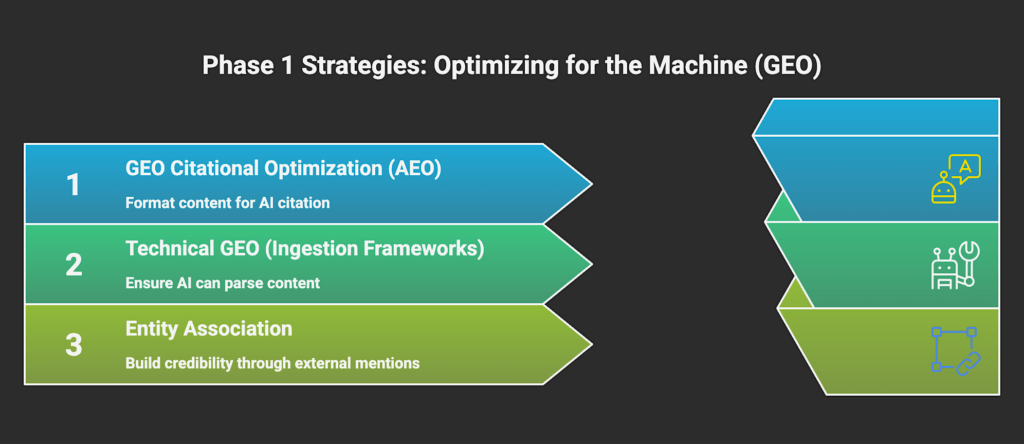
Phase 1: Optimizing for the Machine (GEO)
Strategy 1: GEO Citational Optimization (AEO)
Generative engines favor the path of least resistance. When an AI model scans your content for an answer, it will skip past dense paragraphs and cite a competitor who provided a clean, definitive summary instead. GEO Citational Optimization, also called Answer Engine Optimization (AEO), closes that gap by formatting your content so it is easy to snap up and cite.
One of the most practical ways to implement this is to place a 40–60 word “Answer-First” summary immediately after each H2 header. It creates a standalone block that gives the AI a ready-made snippet, making it effortless for it to confirm you have answered the query and cite your section accordingly.
Strategy 2: Technical GEO (Ingestion Frameworks)
Even well-written content can go unnoticed if AI crawlers cannot cleanly parse your site. Traditional search spiders and AI crawlers operate very differently, and if your website architecture creates friction, AI models will omit your brand from vendor comparisons.
Start by adding an llms.txt file to your domain, which is a plain-text summary of your site built specifically for LLMs to ingest so they understand your value propositions without navigating messy HTML. Then, expand your schema markup to include Product, Organization, and FAQ structured data to make it easier for an AI to verify your business details with precision.
Strategy 3: Entity Association (The Outer Loop)
Your website is the inner loop of your brand authority, which is the place where your expertise lives. The Outer Loop is the ecosystem of trusted third-party platforms, publications, and industry hubs where AI models go to validate that expertise.
Generative models assess credibility through co-occurrence, meaning how often your brand name appears alongside category-specific keywords on those external platforms. The more consistently you appear there, the stronger the signal to AI that your brand is a recognized leader in your space.
A targeted Digital PR strategy is the most direct path to building that presence. The goal is to secure meaningful mentions on the high-authority publications that act as the source of truth in your category. When your brand appears in the right context, in proximity to the specific problems you solve, AI models build a clear association between your name and your core service categories.
Phase 2: Optimizing for the Human (Authority SEO)
Strategy 4: Pivot to GEO-Resilient BOFU Content
Bottom-of-funnel content is your final opportunity to convert a researcher into a lead, and it is also your most defensible territory in the zero-click era. Generative engines are capable at surface-level summaries but hit a ceiling with real-time, highly proprietary, or deeply comparative data. That ceiling is your advantage.
BOFU queries like detailed competitor comparisons and granular pricing breakdowns still drive high-intent clicks because buyers need a primary source for final validation, and no AI summary can substitute for that.
Build comprehensive comparison pages that go beyond surface-level feature lists, incorporating the technical nuances and proprietary data points that generative engines cannot synthesize. Publish transparent pricing frameworks with enough granular detail that prospects validating cost structures against their budget have no choice but to visit your site. When the buyer realizes the AI has only scratched the surface, your page should be the definitive destination they turn to.
Strategy 5: SME-Led Authority
Your internal subject matter experts (SMEs) hold insights, proprietary benchmarks, and firsthand experience that cannot be replicated or summarized by AI. Because generative models can only synthesize what is already publicly known, surfacing that expertise provides genuine Information Gain and positions your brand as the source of truth in your niche.
Conduct deep-dive interviews with your engineers, product leads, and executives to extract knowledge that is not already public. Publish that knowledge as original research or Lessons Learned case studies that act as source material for your industry, and generative engines will treat your content as the primary reference point on that topic.
Strategy 6: High-Utility Interactive Assets
High-utility interactive assets provide value that AI cannot replicate and establish your site as a primary source by creating a functional reason to visit your domain. Because they require proprietary user inputs to generate a meaningful output, they serve as high-intent lead capture mechanisms that bridge the gap between anonymous AI discovery and direct customer engagement.
Build assets like ROI calculators, audit checklists, product configuration wizards, or decision matrices tailored to your audience’s specific workflow needs. These assets earn high-authority backlinks from industry peers, strengthening your domain authority over time.
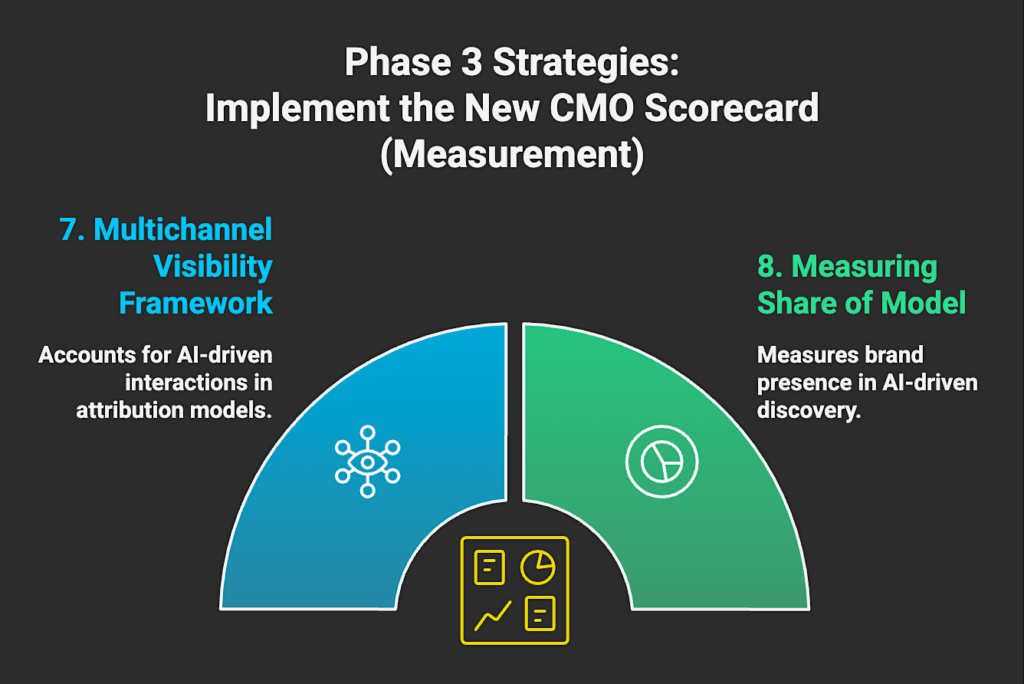
Phase 3: Implement the New CMO Scorecard (Measurement)
Strategy 7: The Multichannel Visibility Framework
Standard attribution models assume the customer/buyer journey begins with a click to your website, so when searchers consume your expertise inside an AI summary, that touchpoint registers nowhere in your current data. The Multichannel Visibility Framework accounts for this blind spot by implementing an attribution model that correlates your generative engine presence with the brand signals that appear later in the funnel.
To do this, track lifts in branded search volume via Google Search Console and direct traffic via GA4 as the primary indicators of your zero-click search and GEO visibility success. Leverage platforms like Limy or HubSpot AEO to track and measure the outcomes of AI-driven interactions. As a HubSpot Platinum Solutions Partner, mvpGrow can integrate these metrics directly into your CRM so you can connect AI visibility to revenue.
Strategy 8: Measuring Share of Model
In 2026, traditional Share of Voice no longer reflects how buyers actually discover solutions. The critical metric now is Share of Model: the percentage of target queries where your brand is a cited source. If AI platforms consistently name your brand during the discovery phase, you secure a place in a potential customer’s consideration set before they ever visit your website.
Track your brand’s Share of Model using platforms like Semrush or Similarweb to audit your citation rate. Benchmark it against your top competitors regularly to identify where the AI is favoring other providers, so you know what content needs to be optimized.
Winning in a Zero-Click Search World
Zero-click search has fundamentally changed how brands get discovered, evaluated, and chosen. Buyers are forming their consideration sets inside AI-generated answers before they ever visit a website, which means traditional SEO alone is no longer enough. Share of Model is the new market share, and the brands that earn it are the ones that show up in AI-generated answers and give buyers a reason to click when it counts.
mvpGrow helps brands win in zero-click search by delivering all three phases through its SEO, GEO, and Content Services. Our expert team builds custom, data-driven, full-funnel content strategies optimized for both traditional search and generative AI engines. The results are stronger brand authority, increased AI visibility, more qualified traffic, and a sales pipeline fueled by high-value leads.
Book a free consultation today to discover how mvpGrow boosts your click-through rate with optimized SEO and GEO.
Turn insights into pipeline.
Book a strategy call and we'll map your GTM gaps in 30 minutes.
Book a time