
Top 10 Lead Enrichment Tools
Most GTM teams don’t lose deals because they lack leads. They lose deals because the leads arrive without enough context, which destroys pipeline efficiency. This context issue means inbound and outbound records show up with missing information, like account matching.
Data quality is already a measurable revenue leak. 31% of CRM admins say poor-quality data costs them at least 20% of annual revenue, and nearly a quarter said less than half their data is accurate and complete. Lead enrichment tools exist to fix that execution layer, turning a simple form fill into an actionable buyer profile the moment it hits your stack.
What are lead enrichment tools?
Lead enrichment tools take incomplete or raw lead data and turn it into usable buyer profiles. They pull verified context from multiple data sources to fill in missing details, such as job role, seniority, company size, industry, location, and tech stack, providing your GTM teams with usable context instead of guesswork.
These tools solve a simple but expensive problem: most inbound leads and outbound prospects lack the context required for confident action.
For B2B SaaS and tech teams, this context is the difference between treating every form fill or prospect record as equal and making fast, informed decisions about who to prioritize, how to route, and how to engage.
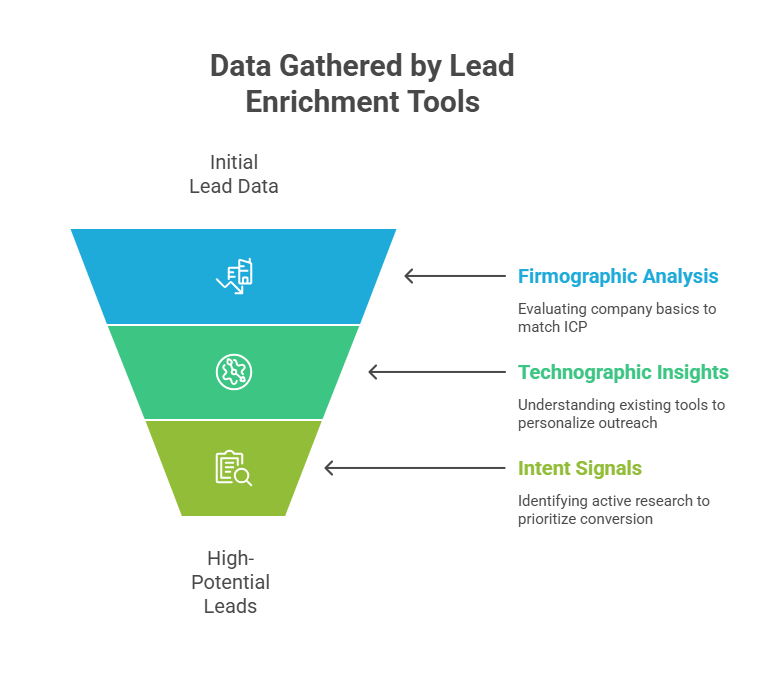
That context usually comes in three layers:
- Firmographic context answers “should we care?” Industry, headcount, revenue range, and location determine ICP fit and routing ownership.
- Technographic context answers “will this conversation make sense?” Knowing what tools an account already runs prevents misaligned pitches and enables competitive or partner-led messaging.
- Intent signals answer “why now?” They surface which accounts are actively researching or comparing solutions, allowing teams to focus on the pipeline that can convert this quarter.
That context is what allows marketing, sales, and RevOps to operate from the same source of truth, a core goal of GTM engineering. Enrichment can happen at multiple points in your GTM motion: in real time when a lead submits a form, in bulk when building outbound lists, or continuously within your CRM as records age.
Types of Lead Enrichment Tools
Not all lead enrichment tools solve the same problem, and treating them as interchangeable is where most GTM stacks start to break down. Most B2B teams end up using more than one category, either natively or as part of a broader stack.
- Real-time form enrichment (inbound): These tools enrich leads the moment they convert. For inbound, enrichment happens as soon as someone submits a form, filling in missing firmographic, role, and account data.
- Bulk or list (outbound): Designed for SDR and growth teams, bulk enrichment tools fill in missing data across large contact or account lists. They’re commonly used before outbound sequences go live to improve targeting and reduce wasted touches.
- Technographic: Technographic tools identify technologies like CMS platforms and cloud providers. This data is especially useful for ICP filtering, competitive displacement messaging, and partner-led targeting.
- Intent and data signals: These platforms aggregate first, second, and third-party buying signals to estimate which accounts are in the market. They identify accounts, score intent, and activate it, rather than just showing research activity.
- Workflow orchestration layers: This category goes beyond static data. These tools connect enrichment sources and automate the flow of enriched data into scoring, routing, outbound sequencing, and reporting.
Key Features to Look For in Lead Enrichment Tools
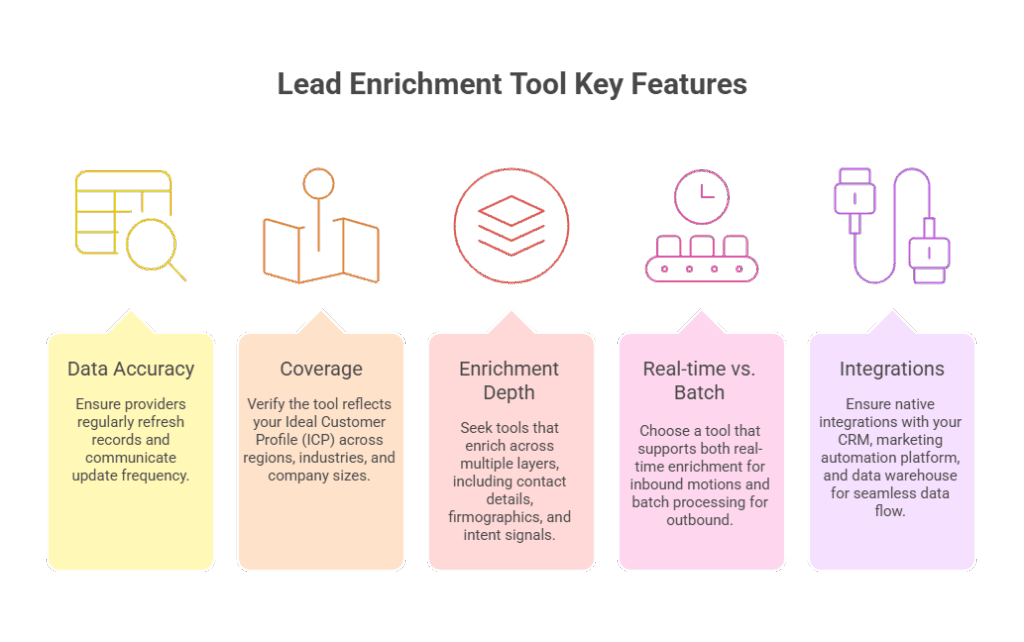
- Data accuracy and refresh frequency: Look for providers that regularly refresh records and clearly communicate how often data is updated, rather than relying on static or crowdsourced databases.
- Coverage by region, industry, and company size: If a tool doesn’t reflect your ICP, it doesn’t matter how much data it returns because you’ll still be routing the wrong leads to sales.
- Enrichment depth: Basic contact data isn’t enough. The best tools enrich across multiple layers: contact details, firmographics, technographics, intent signals, and role or seniority mapping.
- Real-time vs. batch: Inbound motions benefit from real-time enrichment at the point of capture, while outbound and database cleanup require batch processing. Ideally, a tool (or stack) supports both.
- Native integrations and data connectivity: Enrichment only works if it flows into your systems of record; otherwise, that insight stays trapped as dark data. Look for native integrations with your CRM, marketing automation platform, outbound tools, and data warehouse.
Benefits of Lead Enrichment Tools
- Improved handoffs and higher-quality outreach: Enrichment reduces friction both when leads enter your funnel and before outbound outreach begins. Inbound leads arrive pre-qualified and correctly routed, while outbound lists are enriched with firmographic, technographic, and intent data.
- Stronger ICP filtering across inbound and outbound: Enrichment helps you enforce ICP boundaries before a lead ever hits the CRM and before an outbound sequence goes live. You stop treating “anyone who fills out a form” as a lead and start prioritizing accounts that actually match your buying patterns.
- Faster qualification and routing: Enriched firmographics and job data power smarter lead scoring and routing for inbound conversations, while real-time enrichment of outbound lists supports higher conversions.
- More consistent automation across your GTM stack: Enrichment is the fuel behind automated GTM workflows; scoring, territory assignment, sequence enrollment, alerts, and even renewal/expansion targeting. It also powers GenAI use cases like personalization at scale.
- Cleaner data for reporting and attribution: Reliable enrichment enhances lifecycle reporting, cohort analysis, and channel attribution by standardizing data across inbound and outbound records.
Top 10 Lead Enrichment Tools
Category 1: Core B2B Lead Enrichment Platforms
1. Clearbit (HubSpot Breeze Intelligence)
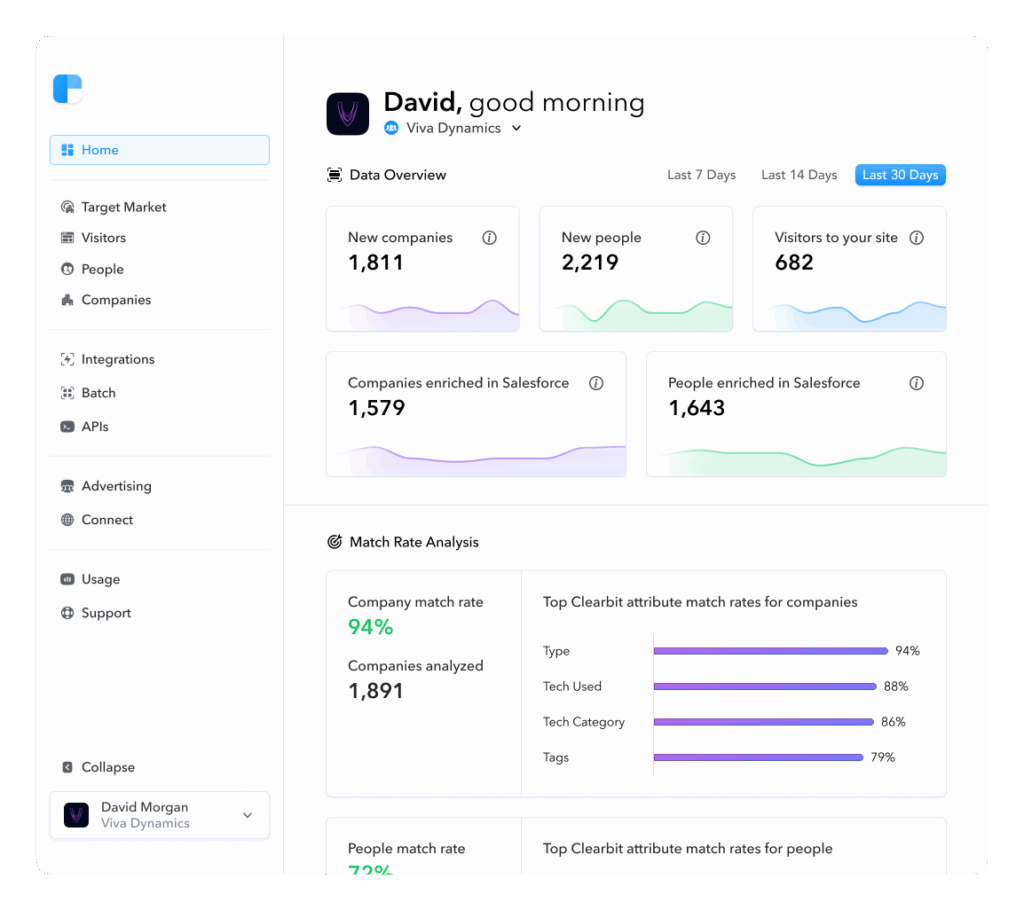
Clearbit is positioned as anative enrichment layer for HubSpot users with strong HubSpot integrations. It provides contact and company records, supporting faster routing and segmentation, with optional buyer-intent and form-shortening capabilities.
Main features:
- Buyer intent signals within HubSpot (useful for prioritization and ABM plays).
- Form shortening.
- HubSpot-native workflows (feeding lead scoring and routing) via standard HubSpot tooling.
Best for: B2B teams already using HubSpot who want to shorten forms within the CRM.
Pricing: Credit-based and tied to HubSpot’s credits/billing model.
Review: “Combining that data with what we get in Hubspot and Google Analytics has been a game-changer for optimizing our web experience.”
2. Apollo.io Enrichment
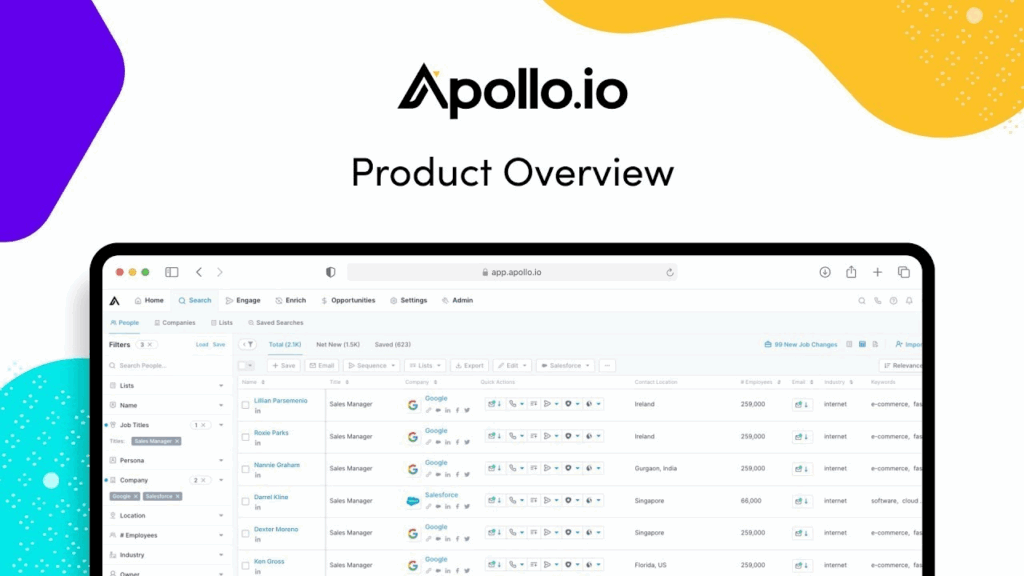
Apollo.io helps you append and refresh contact and account data using Apollo’s database, with a focus on keeping CRM and marketing automation records accurate as they age.
Main features:
- Contact and account enrichment to fill missing fields.
- Real-time enrichment for CRM/MAP workflows.
- Integrations and export/sync workflows.
Best for: Teams that want prospecting and enrichment in one platform.
Pricing: The Basic pricing starts at $49/user/month and scales up by tier.
Review: “I think Apollo can help you find names, but in terms of setting up campaigns and tracking leads, it is very clunky.”
3. UpLead
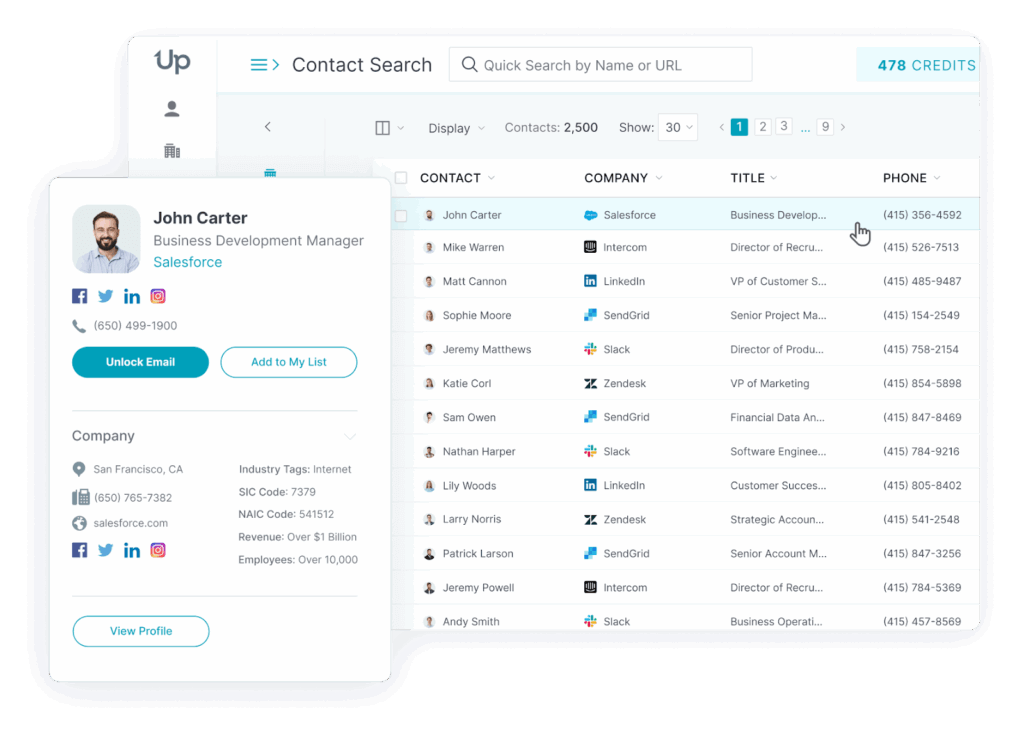
As a core B2B data provider with a strong emphasis on data quality and verification, UpLead provides you with accurate contact and company details for outbound targeting. If your GTM motion depends on reliable emails and you want programmatic access via API, UpLead is built for that.
Main features:
- B2B contact and company data for list building and enrichment.
- API access to enrich and manage contact/company data programmatically.
- Filtering capabilities (industry, location, company attributes, and more) to tighten targeting.
Best for: API-driven enrichment without committing to a heavy enterprise data contract.
Pricing: After the free trial, pricing ranges from $99/month to $199/month.
Review: “The platform makes it easy to find accurate, verified leads quickly, which saves a lot of time in prospecting.”
4. Lead411
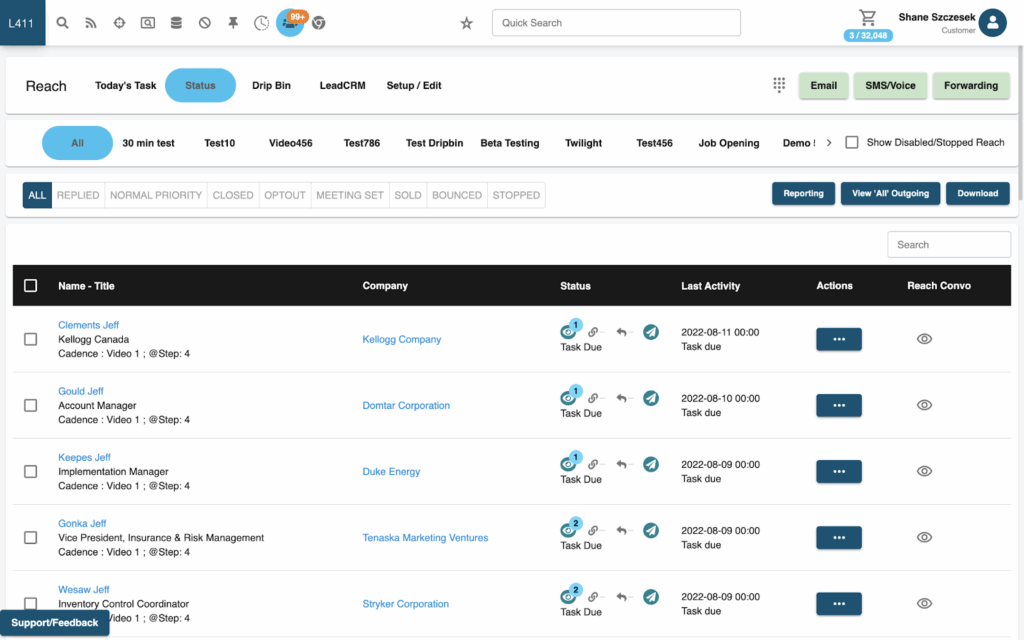
Lead411 positions itself as an “intent-fueled” B2B data platform with a focus on verified contact data and company growth signals. It also offers a dedicated CRM enrichment layer/API to update records and reduce stale data across common CRM stacks.
Main features:
- CRM Enhancer and Contact Enrichment API with integrations across common CRMs.
- Intent and lead scoring, plus growth signals based on triggers like hiring.
- Verified contact database with automated updates on a stated cadence.
Best for: Verified emails and direct dials, as well as growth and intent-style triggers.
Pricing: Unlimited data starting at $49 per month.
Review: “I like how accurate and up-to-date the contact data usually is. It makes it much easier to find the right people and reach out quickly.”
5. Lusha
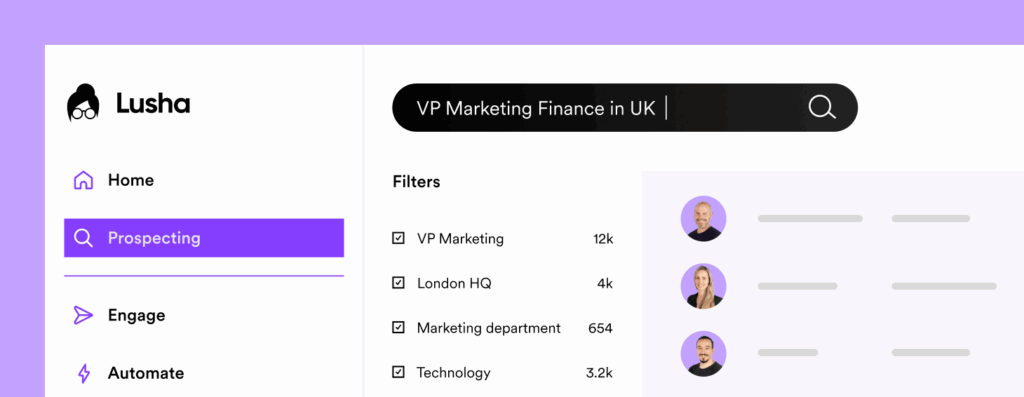
Lusha’s sales intelligence platform supports lead enrichment through multiple paths, including CSV and API. This functionality enables you to append missing contact and company data wherever records reside, so your dashboards aren’t skewed by incomplete fields.
Main features:
- Broad integrations, such as HubSpot, Salesforce, Outreach, and LinkedIn Sales Navigator).
- HubSpot CRM workflows.
- Signals/alerts via API.
Best for: Fast contact enrichment if your reps live in LinkedIn and a CRM.
Pricing: Credit-based model. 40 credits/month is free, and the price rises to $52/month for 7,200 annual credits.
Review: “I especially like how easily it integrates with LinkedIn and CRM tools like HubSpot and Salesforce.”
Category 2: Technographic Enrichment Tools
6. BuiltWith
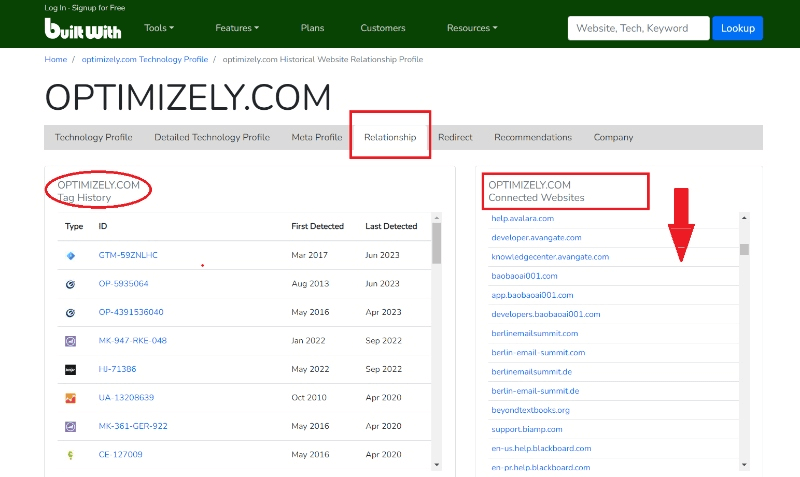
Moving on to technographic tools, BuiltWith identifies the technologies running on millions of websites. Instead of focusing on contact details, it enriches account-level data by revealing tools like marketing automation platforms.
Main features:
- Company-level enrichment that maps technology stacks to domains and accounts.
- Historical tech tracking, allowing teams to see when companies adopt or drop specific tools.
- List building and exports.
Best for: B2B teams seeking to understand the technologies a company utilizes.
Pricing: Subscription-based pricing model with tiered plans.
Review: “We use it to identify websites running our competitors’ tools and to understand the tech environment of companies our sales team is meeting with.”
Category 3: ABM and Intent Platforms with Enrichment
7. 6sense
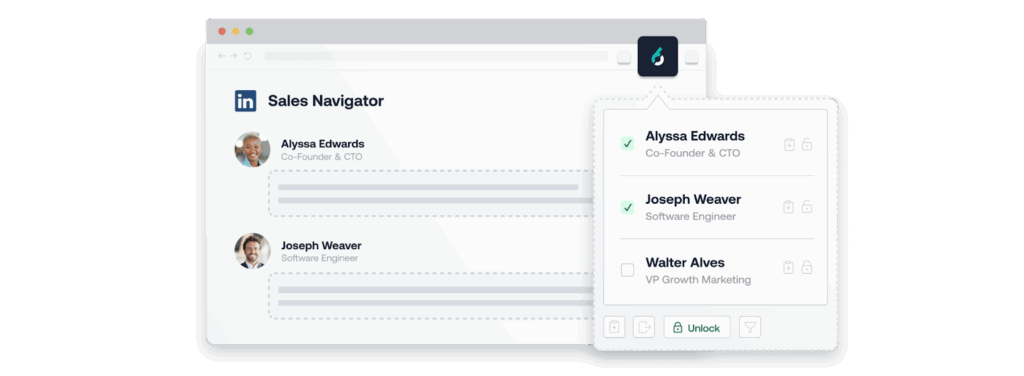
Built for account-based targeting powered by buying signals, 6sense helps you identify which accounts are showing intent and prioritize them accordingly. Its strength is in surfacing anonymous buying signals and helping teams focus on higher-likelihood accounts.
Main features:
- Sales Intelligence credits to unlock/export emails.
- Predictive scoring to rank accounts/contacts by fit and engagement.
- ABM activation.
Best for: ABM programs where “in-market detection” matters more than raw contact volume.
Pricing: By inquiry.
Review: “The integration with Salesforce makes audience targeting even better, allowing you to differentiate your audiences between Prospect and Customer and the very stages of the sales cycle.”
8. Demandbase
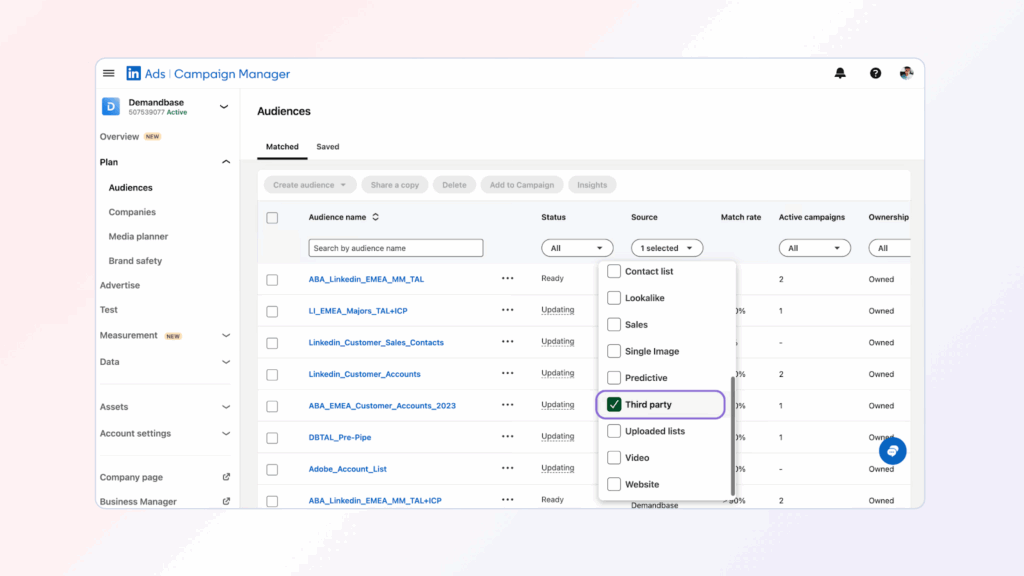
Demandbase One positions itself as a unified go-to-market platform, offering account intelligence, intent, advertising, and personalization all in one place. The AccountID and enrichment signals help you recognize visitors/accounts and personalize experiences.
Main features:
- Intent data and account intelligence to prioritize accounts.
- Plug-and-play integrations via a marketplace.
- Sales workflows (“Plays”) that surface the best accounts/contacts.
Best for: A broader “go-to-market platform” that includes ads, intent, and AI.
Pricing: By inquiry.
Review: “I use Demandbase One daily to review intent data across our target accounts and find it incredibly valuable in identifying insights that help build and progress the sales pipeline.”
Category 4: Enrichment and Workflow Automation
9. Clay
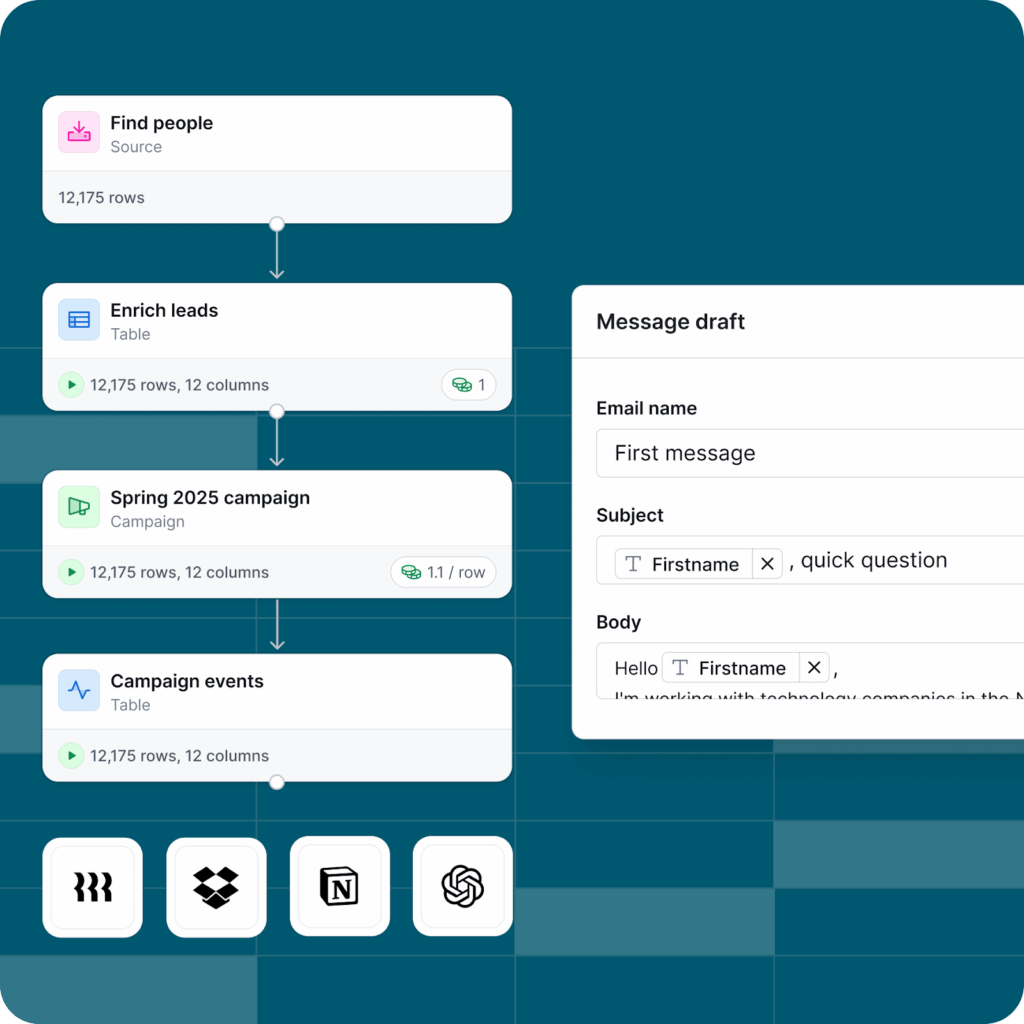
Clay is best thought of as a GTM automation workspace. You bring a list, then Clay enriches it using multiple providers in sequence. Instead of betting on one database, Clay is built to combine providers and workflows so enrichment actually translates into action.
Main features:
- Query multiple providers sequentially to increase match rates for datapoints.
- 150+ providers and integrations.
- GTM table UX and AI support for research and drafting steps.
Best for: RevOps, growth, and SDR ops that want to orchestrate enrichment across multiple sources.
Pricing: Credit-based pricing ranging from $134/month to $720/month.
Review: “The tool allows me to work much faster and independently, completing tasks that used to take me two days in under an hour.”
Category 5: Your GTM Engineering Partner
10. mvpGrow
Most tools stop at “here are the missing fields.” mvpGrow goes further by designing and operating lead enrichment systems as part of GTM engineering, so enriched data actually changes how revenue teams operate.
We build enrichment tools tailored to your ICP, data sources, and workflow, delivering real-time enrichment at the moment leads enter your stack. Every inbound lead and outbound prospect is enriched with the context needed for accurate scoring, routing, and personalization.
The mvpGrow approach is designed for B2B SaaS and tech teams that require enrichment to generate a pipeline, not just clean CRM records. We treat enrichment as infrastructure, not a one-off task. That means connecting data pipelines, lead capture, scoring models, routing rules, outbound sequencing, and reporting into one scalable engine that doesn’t break as you move from dozens to thousands of leads per month.
Main features:
- Contact and firmographic enrichment designed to enforce ICP fit and ensure the right leads reach the right teams.
- System-level alignment across marketing, sales, and RevOps so enrichment feeds scoring, personalization, forecasting, and attribution.
- Workflow automation that enriches inbound leads at capture and outbound leads before sequences go live.
Best for: B2B SaaS and tech companies that are growing rapidly and need custom-built enrichment workflows that scale with lead volume.
Pricing: Contact the mvpGrow team for a customized package.
Review: “Thanks to mvpGrow’s blog efforts, the client saw a 60% increase in leads. Their ability to express complex ideas, such as cloud computing, data engineering, and automation, made them stand out.”
Build an Enrichment Layer that Actually Changes Outcomes
Lead enrichment tools don’t fail because the data is bad. They fail because teams treat enrichment as a checkbox. But, the real win is better pipeline outcomes through higher-quality leads, faster routing, sharper segmentation, and outbound that targets accounts with real buying signals.
If enrichment isn’t wired into your GTM system, you’re paying for a nicer database and still operating on guesswork. mvpGrow builds an enrichment layer as GTM infrastructure, so it reliably feeds qualification and personalization. That means your inbound doesn’t rot in the CRM, outbound targets real buying signals, and RevOps isn’t constantly patching broken workflows as volume scales.If you want an enrichment layer that holds up as you go from dozens of leads a month to thousands, book a GTM consultation. We’ll map the stack, define the decision logic, and design the workflows so the data actually gets used.
Turn insights into pipeline.
Book a strategy call and we'll map your GTM gaps in 30 minutes.
Book a time